
Why Great Messages Still Fail and Why This Matters
Every organisation depends on effective communication. Whether introducing a new policy, leading organisational change or encouraging collaboration, success is determined not only by what is communicated but by whether people understand it, trust it and act on it.
Yet in today's workplace, communication has become more challenging than ever. Employees are expected to absorb vast amounts of information across multiple channels while balancing competing priorities and increasing workloads. Important messages can easily become lost in the noise.
These challenges formed the focus of our recent webinar, Communicating for Trust, Clarity and Impact, led by communications expert Matt and supported by Tendai. Rather than simply discussing writing techniques, the session explored how organisations can communicate more effectively by building trust, creating clarity and helping people take meaningful action. Through practical examples, audience discussion and live polling, participants identified the common barriers preventing communication from achieving its intended impact—and more importantly, how those barriers can be overcome.
Understanding Today's Communication Challenge
Communication is often viewed as a process of sharing information. In reality, successful communication is about creating understanding.
Modern organisations face an environment where employees receive dozens of emails, attend numerous meetings, monitor several collaboration platforms and manage competing demands throughout the day. The challenge is no longer access to information—it is helping people identify what matters most.
An opening poll asked participants where communication most frequently gets stuck.
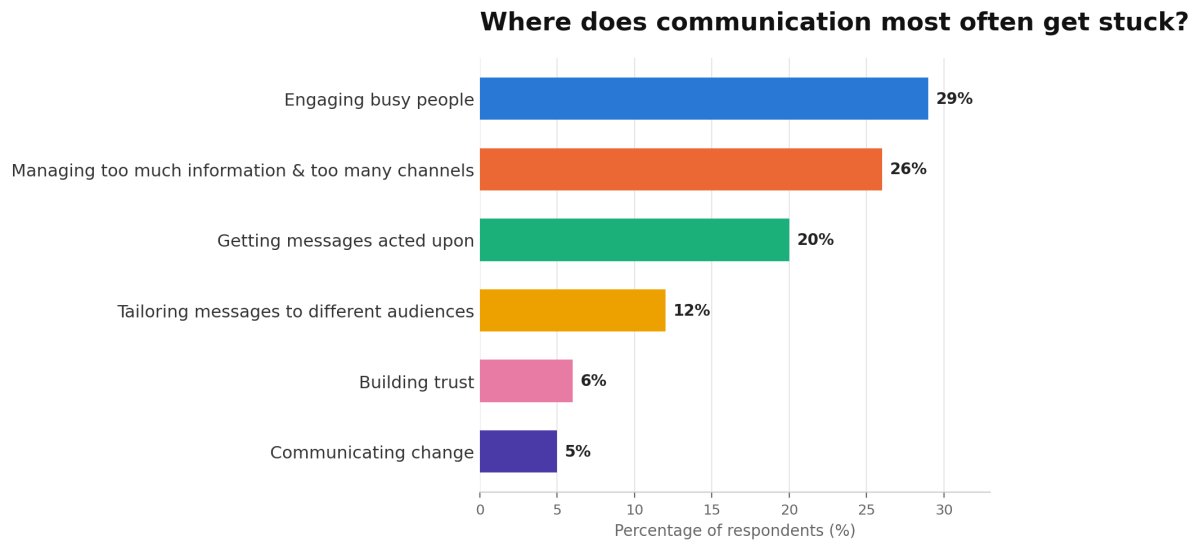
The results reflected the realities of today's workplace:
- 29% said the biggest challenge is engaging busy people.
- 26% identified managing too much information and too many communication channels.
- 20% said organisations struggle with getting people to act on messages.
- 12% highlighted tailoring messages for different audiences.
- 6% identified building trust.
- 5% pointed to communicating organisational change.
The findings reveal that the greatest obstacles are not technological—they are human. Communicators are competing for attention in increasingly crowded environments, making clarity and relevance more important than ever.
Why Messages Don't Land
Later in the session, participants were asked a second question: why do messages fail to land?
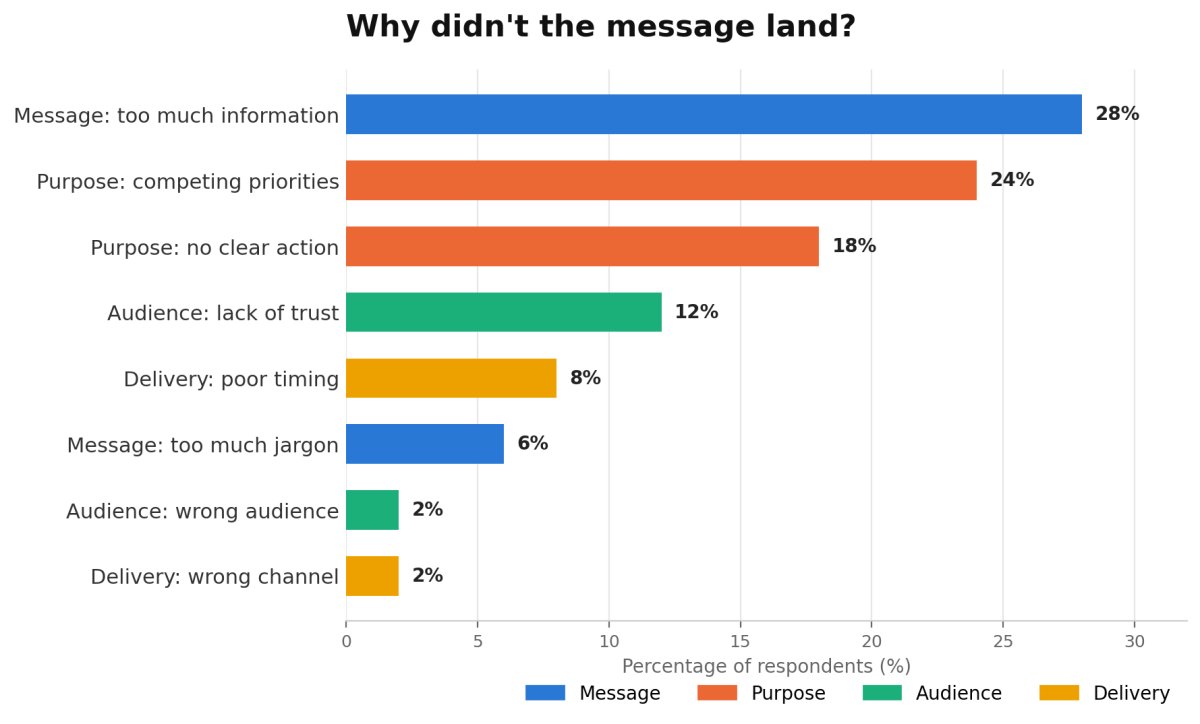
The responses were equally revealing.
- 28% believed messages contain too much information.
- 24% cited competing priorities.
- 18% said communications lacked a clear action.
- 12% highlighted a lack of trust.
- 8% identified poor timing.
- 6% selected too much jargon.
- Only 2% believed the wrong audience or wrong communication channel was the primary issue.
Together, information overload, competing priorities and unclear actions accounted for 70% of responses.
The implication is significant. Organisations often focus on improving communication channels or increasing the volume of communication. However, the findings suggest that the real issue is frequently the quality and focus of the message itself. People are not ignoring communications because they lack access—they are ignoring communications because they struggle to identify what is important and what is expected of them.
Start with Purpose, Not Content
One of the webinar's most practical takeaways was Matt's Know, Feel, Do framework.
Before writing any communication, communicators should answer three simple questions:
- What do people need to know?
- How do we want them to feel?
- What do we want them to do?
This framework encourages communicators to think about outcomes rather than information. Too often, communications become repositories of background information without clearly identifying the central message or desired action.
Matt also discussed the importance of identifying a single core message before drafting. Every communication should have one clear idea that readers can remember long after they have finished reading. If the writer cannot summarise the communication in one sentence, the audience is unlikely to do so either.
Purpose should always come before content.
Build Trust Through Clear, Human Communication
Trust remains one of the foundations of effective communication.
The session explored how credibility is developed through consistency, honesty and transparency rather than authority alone. During periods of uncertainty, audiences often respond more positively to communicators who openly acknowledge what they know—and what they do not—than to those who present incomplete certainty.
Another important theme was avoiding bureaucratic language.
Many workplace communications are filled with technical terminology, passive language and unnecessarily complex sentences. While intended to sound professional, these often create distance between the communicator and the audience.
Instead, organisations should communicate as people speak: clearly, directly and respectfully.
Simplifying language does not reduce professionalism. It improves understanding.
When people can immediately recognise what is being asked of them, they are far more likely to engage with the message.
Respect Your Audience's Attention
One of the strongest themes throughout the webinar was respecting people's time.
Every communication competes with meetings, deadlines, emails and countless other distractions. This means communicators must make important information immediately visible.
Rather than building towards the conclusion, the session encouraged participants to begin with it.
If there is an action, explain it first.
If there is a decision, announce it immediately.
If there is an important deadline, make it impossible to miss.
Matt also challenged participants to rethink editing. Writing is only the first step. Effective editing removes unnecessary information, eliminates repetition and ensures every sentence contributes to the overall objective.
Clear communication is rarely about adding more—it is often about removing what does not need to be there.
Practical Applications
Organisations do not necessarily need new communication platforms to improve engagement. Small behavioural changes can have a significant impact.
Practical steps discussed during the webinar included:
- Start every communication by defining its purpose.
- Use the Know, Feel, Do framework before drafting.
- Lead with the most important message rather than background information.
- Reduce unnecessary detail and avoid information overload.
- Replace jargon with clear, conversational language.
- Tailor communications to different audiences rather than adopting a one-size-fits-all approach.
- Consider timing before sending important messages.
- Edit every communication from the audience's perspective.
These practical habits help organisations communicate with greater clarity while improving engagement and decision-making.
The Leadership Perspective
Communication is ultimately a leadership responsibility.
Leaders influence organisational culture through the way they communicate every day. Clear, honest and consistent communication builds confidence, encourages collaboration and creates alignment across teams.
Conversely, when leaders overwhelm people with unnecessary information, avoid difficult conversations or communicate inconsistently, trust quickly begins to erode.
Leadership communication is therefore about more than delivering messages. It is about creating an environment where people understand expectations, feel informed and have confidence in organisational decisions.
In an increasingly complex world, the ability to communicate with clarity has become one of the defining characteristics of effective leadership.
Key Takeaways
- Great communication creates understanding, not just awareness.
- Start with purpose before writing.
- Use the Know, Feel, Do framework to shape every message.
- Put the key message and required action first.
- Remove unnecessary detail and avoid information overload.
- Build trust through consistency, openness and honesty.
- Respect your audience's time and attention.
- Measure communication by the actions it inspires, not the number of messages sent.
Looking Ahead
The webinar highlighted an important reality for every organisation: communication is no longer about producing more content, it is about producing communication that people can understand, trust and act upon.
The two audience polls reinforced this message. Participants consistently identified information overload, competing priorities and unclear actions as the biggest barriers to effective communication. These are challenges that every organisation can address through better planning, clearer writing and stronger leadership.
Ultimately, effective communication is not measured by the number of emails sent, reports written or meetings held. It is measured by whether people understand the message, remember it and know exactly what to do next. Organisations that communicate with clarity and purpose will not only engage their people more effectively but will also build stronger relationships, greater trust and better outcomes over the long term.