Start with the Problem, Not the Platform
Practical lessons from an AI Essentials session for senior government officials from Malaysia
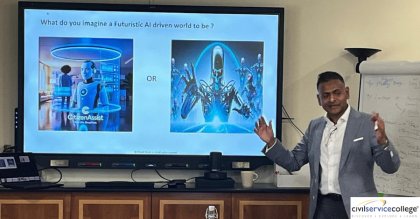
Drawing on this experience, Niresh led a recent AI Essentials session for senior government officials from Malaysia. The session explored responsible and effective AI adoption through real public-sector challenges, including education, urban planning, workforce management, reporting, asset management and service delivery. The central lesson was clear: successful AI adoption begins with a well-defined public-service problem, not with the purchase of a new tool.
The first question should not be “Which AI tool?”
Public-sector organisations are under pressure to respond to rapid advances in artificial intelligence. Drawing on his experience of leading complex transformation, Niresh explained why technology selection should not be the starting point. Before choosing a platform or model, leaders need to be clear about the process they want to improve, the people who should benefit, the information required and the risks that must be managed.
A useful starting point is to identify a small number of potential use cases and assess each one against six practical considerations: process, beneficiaries, data, value, feasibility and risk. In the public sector, value should not be measured only in financial terms. It may also mean time saved, more consistent services, stronger productivity or a better experience for citizens.
|
Key insight: define the outcome first, then decide whether AI is the right intervention. |
Use AI to strengthen professional judgement, not bypass it
One of the most important questions from the session was how AI can support experts without replacing their knowledge and judgement. The answer lies in designing AI around accountability. AI can help professionals analyse large volumes of information, identify patterns and reduce repetitive work, but it does not carry the experience, institutional context or responsibility of the person making the final decision.
The strongest use cases therefore keep people meaningfully involved. The objective is not to hand over responsibility, but to give experts more time for analysis, advice, challenge and citizen-facing work. Human oversight should be designed into the process from the beginning, especially where outputs may affect public services or important decisions.
Trust depends on evidence, not confidence
AI-generated answers can sound authoritative even when they are incomplete or wrong. That makes verification a governance requirement rather than an optional final check. Officials should be able to explain what information was used, where it came from, how it was transformed, what assumptions were made and where limitations remain.
This is particularly important for forecasts and recommendations presented to senior leaders. A headline accuracy figure is not enough. Decision-makers need a clear account of data quality, methodology, assumptions and uncertainty, together with a named person who remains accountable for the final output.
Better AI begins with better data
The quality of an AI system is closely connected to the quality of the data behind it. Fragmented records, legacy systems, inconsistent classifications and unclear ownership can all weaken results. More data does not automatically mean better evidence.
Niresh encouraged participants to test whether data is complete, accurate, consistent, relevant, accessible and traceable to its source. This reframes AI adoption as part of a wider data and operating-model transformation. Organisations that overlook those foundations may scale uncertainty rather than value.
Plan for how work and skills will change
Niresh described three ways AI can affect work: it can augment existing roles, automate specific activities and create new forms of work. The leadership task is to decide which activities fit each category, while protecting the opportunities through which employees develop expertise and critical thinking.
This is especially relevant for graduates and junior staff. If AI performs too much of the foundational work, organisations risk weakening the route through which future experts learn. Adoption plans should therefore include role redesign, workforce development and the ability to question AI outputs, rather than focusing only on technical training.
Readiness is an organisational question
The session considered six areas of AI readiness: strategy, leadership, culture and change, workforce capability, technology and data. Together, they show why AI readiness cannot be delegated solely to an IT team. Sustainable adoption requires leadership commitment, clear priorities, usable data, appropriate controls and people who understand both the opportunity and their responsibilities.
Technology can be upgraded and skills can be developed, but lasting change depends on a shared understanding of why AI is being introduced and how it will improve public outcomes. Without that context, even promising pilots can remain disconnected from organisational priorities.
Six questions leaders should ask before adopting AI
- What public-service problem are we trying to solve?
- Who will benefit, and how will we recognise improvement?
- Do we have sufficiently reliable, relevant and traceable data?
- Can we explain and defend the output?
- Where must human judgement and accountability remain?
- Are our leaders, workforce and operating model ready for the change?
The lasting lesson
The organisations most likely to use AI well will not necessarily be those with the most tools. They will be those that define the problem carefully, strengthen their data foundations, involve the people affected and keep humans accountable for decisions that matter.
For public-service leaders, the starting point is not having every answer. It is creating the discipline to ask better questions before technology shapes the response.