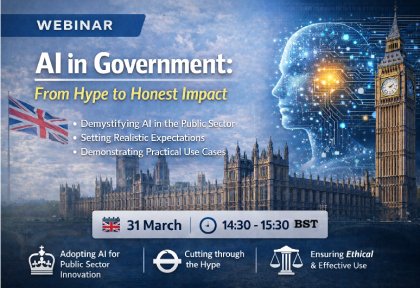
What does meaningful impact with AI really look like in government?
“I’ve seen people save hours with AI and still not trust it.”
When Tom Bryant shared this reflection, it resonated immediately. It was not surprising, but it reflected a reality many recognise.
This tension between what AI can already deliver and how confident people feel using it shaped the discussion hosted by Tendai.
The conversation moved beyond headlines to focus on the practical realities of applying Generative AI in government, where accountability, trust, and complexity must always be considered.
As perspectives were shared from across departments, a more important question began to emerge. If AI is already influencing how work is done, what does meaningful and trusted impact look like?
Why AI in Government Requires a Different Approach
AI now features prominently in public sector strategies, discussions, and expectations. There is clear optimism about its potential.
Early use shows benefits such as improved productivity, faster drafting, and more efficient research. Interest in using AI as part of everyday work is also increasing.
There is, however, a more cautious perspective alongside this momentum. Confidence in outputs remains low. Questions around governance continue to arise. Many are still unclear about what constitutes appropriate use.
As highlighted in the discussion, departments are operating at different stages of the hype cycle. Some are still exploring what is possible. Others are focusing more closely on risks and controls. A smaller number are beginning to see tangible value through structured use and training.
Awareness is no longer the primary challenge. The focus has shifted towards capability and confidence in application.
The Promise Is Real, but Confidence Is Still Developing
AI is already delivering measurable benefits across government.
Many civil servants report saving time, improving the quality of their work, and reducing effort on repetitive tasks. Even modest time savings can have a meaningful impact when considered across teams.
Greater efficiency has not yet led to a comparable increase in confidence.
The gap is not in what the technology can do. The gap lies in how comfortable people feel using it effectively.
As Tom explained, using AI well is a skill that develops over time through practice, guidance, and practical application.
Understanding the Reality: Systems, Skills, and Sensitivity
Barriers to adoption extend beyond the technology itself.
Government operates within complex systems that include governance and approval processes, fragmented and sensitive data, and high levels of accountability. Policy guidance also continues to evolve.
Levels of digital confidence vary across teams, which adds another layer of complexity.
The central issue is alignment. People, policy, and practice need to work together more effectively.
Progress depends on moving from hesitation towards informed experimentation, supported by clear expectations and appropriate safeguards.
What AI Can and Cannot Do
The discussion highlighted where AI is already adding value in practical terms.
AI can support tasks such as summarising large volumes of information, drafting communications, assisting with analysis, and reducing administrative workload. These applications are already visible across government.
Some teams are also exploring more advanced uses, including testing policy ideas through AI-generated scenarios and using simulations to support decision making.
There are clear limitations. AI cannot replace human judgement. It does not fully understand political or cultural context. Accuracy cannot be guaranteed. Responsibility for decisions cannot be transferred to a system.
As emphasised during the session, AI can support decisions, but responsibility remains with people.
From Tool to Thinking Partner
A significant shift discussed during the session was how AI is approached.
When used in a limited way, it remains a tool for producing quick outputs. A more considered approach allows it to become a partner in thinking.
Participants were encouraged to use AI to test assumptions, explore unfamiliar areas, and strengthen their understanding.
Tom suggested a different way of engaging with AI. Rather than focusing only on answers, it can be used to prompt better questions and deeper reflection.
This approach moves the value of AI beyond efficiency and towards improved thinking and decision making.
Developing this capability requires strong prompting skills, critical evaluation, and access to structured learning.
Ethics, Trust, and Accountability
Trust remains central to the use of AI in government.
Human involvement is essential in all decision making. AI can assist with analysis and insight, but accountability must remain with individuals and organisations.
Important considerations include bias in data, the way language reflects assumptions, data protection, and maintaining public confidence.
Responsible use of AI requires not only technical understanding, but also sound judgement and ethical awareness.
Moving Towards Meaningful Impact
Progress is more likely to come from focused and practical action than from large-scale transformation alone.
A clear approach begins with identifying relevant use cases that support everyday work. Defining success early helps maintain focus. Building capability alongside implementation ensures that value can be sustained.
Impact is driven by relevance and application rather than ambition on its own.
Key Takeaways
- AI is already improving efficiency, while confidence continues to develop
- Skills, mindset, and governance remain the main challenges
- Greater value is realised when AI supports thinking rather than simple tasks
- Accountability must remain with people
- Training is essential to build confidence and capability
- Ethical considerations require ongoing attention
- Practical use cases provide the strongest foundation for progress
Closing Reflection
This shift is not only about technology. It reflects a broader change in how work is approached and decisions are made.
AI will continue to evolve, but the more significant change lies in how people question, interpret, and apply insight.
Technology does not transform organisations on its own. Transformation depends on how it is used.
The question is no longer whether AI will influence government. The more important question is how government will shape its use in a way that delivers lasting public value.